
"Abstract
At the time of writing of this article, there have been over 110 million cases and 2.4 million deaths worldwide since the start of the Coronavirus Disease 2019 (COVID-19) pandemic, postponing millions of non-urgent surgeries. Existing literature explores the complexities of rationing medical care. However, implications of non-urgent surgery postponement during the COVID-19 pandemic have not yet been analyzed within the context of the four pillars of medical ethics. The objective of this review is to discuss the ethics of elective surgery cancellation during the COVID-19 pandemic in relation to beneficence, non-maleficence, justice, and autonomy. This review hypothesizes that a more equitable decision-making algorithm can be formulated by analyzing the ethical dilemmas of elective surgical care during the pandemic through the lens of these four pillars...
Conclusion
The ethics of postponing non-urgent elective surgical procedures during this COVID-19 pandemic are complex. Each tenet of medical ethics can be referenced to support or contest cancellations. Ultimately, while the decision to postpone elective cases was made appropriately in the short term during first surge of COVID-19 cases, it would be reasonable to expect downstream consequences which are harmful to patients whose surgeries were postponed...
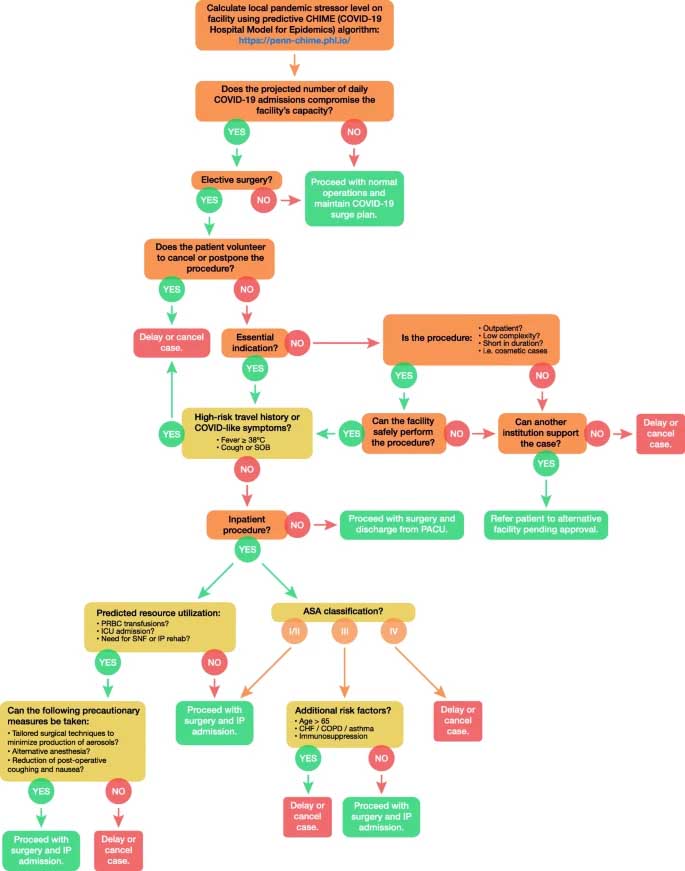
Until 2020, much of the work done to optimize triage algorithms for pandemic preparedness relied on smaller scale outbreaks such as the 2009 H1N1 or 2014 Ebola epidemics. The scale and severity of this pandemic has forced local, regional, and national governments to work outside the bounds of existing algorithms, and forced most developed healthcare systems to temporarily postpone elective surgeries as a result. While the decision to postpone elective surgeries might not have been avoidable, we contend that postponing these surgeries in the most ethical manner should involve relying on a triage algorithm which maximizes beneficence and minimizes non-maleficence – such as that proposed by Stahel et al. – but also incorporates local variability in resources and disease burden to maximize justice. An example of this modified algorithm is shown in Fig. 2. In addition to including the same core decision tree as previous algorithms, this example addresses patient autonomy and the justice principle directly, and stresses the needed collaboration between healthcare providers and recipients. As is clear from the figure, this algorithm is complex, but its implementation necessitates considering factors such as hospital surge capacity, available ICU beds, PPE, ventilator availability, local COVID-19 disease burden, and rates of transmission. Nevertheless, more comprehensive algorithms enable a degree of flexibility which is less vulnerable to ethical criticism, and (hopefully) more effective in maximizing quality care to patients. As the United States prepares for another major surge, these considerations will be paramount to limit the delayed consequences of another widespread postponement of non-urgent elective cases."
© The Author(s). 2021
Open Access This article is licensed under a Creative Commons Attribution 4.0 International License,
which permits use, sharing, adaptation, distribution and reproduction in any medium or format, as long as you give appropriate credit to the original author(s) and the source, provide a link to the Creative Commons licence, and indicate if changes were made. The images or other third party material in this article are included in the article's Creative Commons licence, unless indicated otherwise in a credit line to the material.